


How many Czech websites block AI crawlers
We counted how many major Czech websites and e-shops block ChatGPT, Claude, and Perplexity. Many blocks never appear in robots.txt—the firewall or e-shop platform decides.
From a Tokyo server, we tested the top 1,000 .jp domains on AI crawlers. Of the 518 sites that responded, a quarter block at least one—matching Czechia, but in a different way.

Almost the same share of major Japanese websites block at least one AI crawler as Czech ones. Yet websites blocking AI crawlers in Japan draw the line elsewhere: Japanese sites disallow AI search bots in robots.txt nearly twice as often as Czech sites. Czech sites, in turn, block AI crawlers at the firewall more often than Japanese ones.
We tested the Japanese sites from a server in Tokyo so they would respond as they do to a visitor in Japan.
126 of 518 reachable Japanese sites (24.3%) and 208 of 819 Czech sites (25.4%) block at least one AI crawler, either in robots.txt or at the firewall. The share is nearly identical, though the path differs.
An AI crawler downloads pages to train language models (OpenAI's GPTBot) or to cite them with a link (OAI-SearchBot). Robots.txt is a public file where site owners state where each bot may go—like a sign on the door. A hosting or Cloudflare firewall acts as a doorman: it turns a bot away even if the sign says nothing. Read more in Blocking AI crawlers.
The sites come from the Tranco ranking: the top 1,000 .jp and 1,000 .cz domains.
| What we found | Czechia, Nov 19 (819 sites) | Japan, Nov 23 (518 sites) |
|---|---|---|
| Blocks at least one AI crawler | 208 (25.4%) | 126 (24.3%) |
| Blocks GPTBot (robots.txt or firewall) | 146 (17.8%) | 89 (17.2%) |
| Disallows at least one training bot in robots.txt | 152 (18.6%) | 98 (18.9%) |
| Disallows GPTBot in robots.txt | 97 (11.8%) | 67 (12.9%) |
| Disallows an AI search bot in robots.txt | 41 (5.0%) | 47 (9.1%) |
| Blocks GPTBot at firewall only (lower estimate) | 49 (6.0%) | 22 (4.2%) |
| Blocks an AI search bot at firewall (lower estimate) | 65 (7.9%) | 28 (5.4%) |
| Behind Cloudflare | 191 (23.3%) | 41 (7.9%) |
| Has an llms.txt file | 85 (10.4%) | 32 (6.2%) |
Firewall numbers are a lower estimate: we count only explicit rejections on sites that, in the same minute, allowed a browser and a control request posing as Google's bot.
On 37 unreachable Japanese sites, we could still read robots.txt: 6 disallow GPTBot. Among reachable sites with robots.txt, that figure is 67 of 389. The missing sites do not differ much.
Japanese sites disallow AI search crawlers in robots.txt nearly twice as often as Czech sites: 47 of 518 Japanese sites (9.1%) shut out at least one, versus 41 of 819 Czech sites (5.0%). We count six bots from ChatGPT, Claude, and Perplexity that crawl for search or fetch pages when a user asks.
According to OpenAI's documentation, disallowing GPTBot means content should not train models. A site that disallows OAI-SearchBot also will not appear in ChatGPT search.
Among sites that disallow training, 119 of 152 in Czechia (78.3%) allow both bots ChatGPT uses for search (OAI-SearchBot and ChatGPT-User). In Japan, 54 of 98 (55.1%) allow both, while the remaining 44 disallow at least one. Most Czech sites block only training; Japanese sites do so only about half the time.
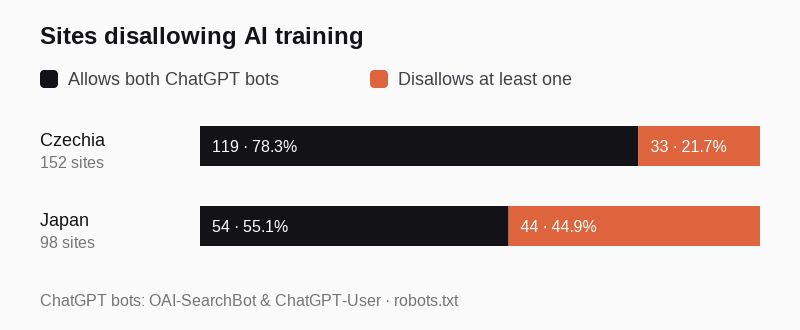
Japanese sites even disallow ChatGPT-User (44 of 518) more often than OAI-SearchBot (34). Yet OpenAI notes that robots.txt rules may not apply to ChatGPT-User because it opens pages at a human's request.
The data cannot tell us why Japanese sites choose differently. Moreover, robots.txt is a request, not a lock: well-behaved bots follow it, but it does not stop them technically.
We picked the ten highest-ranked Japanese sites that returned a page and explicitly disallow GPTBot in robots.txt. Six also disallow AI search bots; four allow them. Rankings apply among .jp domains in Tranco, which measures domain popularity, not traffic. We read the robots.txt lines on Nov 23, 2026.
| .jp rank | Domain | Disallowed AI search bots (of 6) |
|---|---|---|
| 1 | yahoo.co.jp | none |
| 2 | amazon.co.jp | all 6 |
| 45 | nicovideo.jp | none |
| 53 | yomiuri.co.jp | all 6 |
| 57 | mainichi.jp | 5 |
| 79 | nhk.jp | 3 |
| 88 | chunichi.co.jp | all 6 |
| 99 | nishinippon.co.jp | all 6 |
| 107 | game8.jp | none |
| 114 | minkabu.jp | none |
The first domain, yahoo.co.jp, disallows only GPTBot and Google-Extended out of 22 tracked AI bots, and allows search bots. The second, amazon.co.jp, disallows 18 of 22 bots, including all six search bots. Public broadcaster nhk.jp disallows OAI-SearchBot, ChatGPT-User, and PerplexityBot, but allows Anthropic's search bots.
Four daily newspapers sit among the six sites that also disallow search bots: yomiuri.co.jp, mainichi.jp, chunichi.co.jp, and nishinippon.co.jp. Lower down the list, sites such as tokyo-np.co.jp and 47news.jp disallow all six search bots. We did not count news sites as a group because several major Japanese outlets run on domains other than .jp.
You can download the robots.txt lines for all sites at the end of this article. We do not publish which sites block bots at the firewall, because from the outside we cannot be sure how a real bot from its own IP addresses would be treated.
The firewall alone—with no robots.txt rule—blocks GPTBot on 49 of 819 Czech sites (6.0%) and 22 of 518 Japanese sites (4.2%). Firewalls block the search bots OAI-SearchBot or PerplexityBot on 65 Czech sites (7.9%) and 28 Japanese sites (5.4%). These are lower estimates.
Cloudflare plays a role: 191 of 819 Czech sites (23.3%) run through it, compared to just 41 of 518 Japanese sites (7.9%). On Czech sites, Cloudflare accounts for 55 of the 83 firewall rejections of GPTBot (the 83 include sites that also disallow GPTBot in robots.txt; the firewall alone blocks it on 49). According to Cloudflare's documentation, the service can insert robots.txt rules for AI bots like GPTBot and ClaudeBot, plus a Content-Signal line, on the owner's behalf. 29 Czech sites and one Japanese site had this managed block; 53 Czech sites and one Japanese site had Content-Signal.
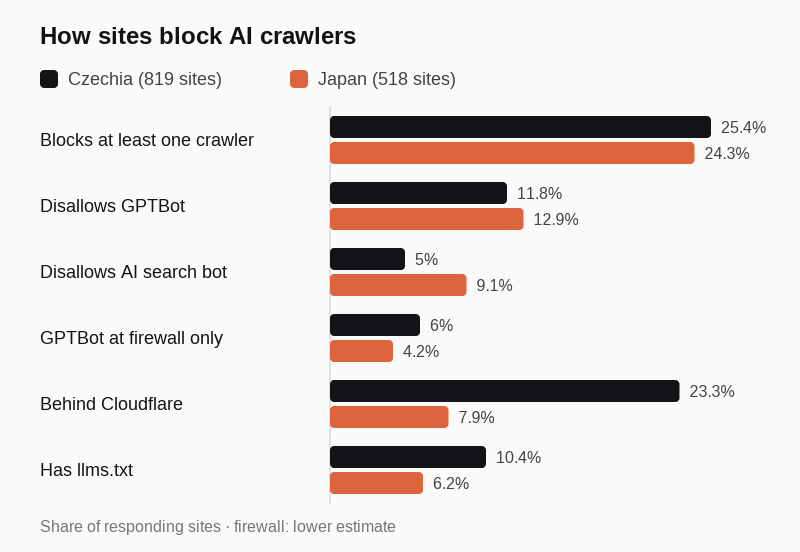
Site owners cannot see firewall blocks in robots.txt and may not know about them. Japanese sites decide visibly in robots.txt more often.
We tested Japan from a data center and Czechia from a home connection. That likely did not skew the gap: from a Prague home connection on Nov 20, 2026, the firewall alone blocked GPTBot on 21 of 485 Japanese sites (4.3%), versus 4.2% from Tokyo.
32 of 518 Japanese sites (6.2%) and 85 of 819 Czech sites (10.4%) have llms.txt, a site summary for language models. 389 of 518 Japanese sites (75.1%) and 728 of 819 Czech sites (88.9%) have robots.txt.
Test location changed which sites responded, not the shares. Between the Prague test and the main Tokyo run on Nov 23, 2026, no share in the main table moved by more than one percentage point. At least one AI crawler was blocked by 118 of 485 sites from Prague (24.3%) and 126 of 518 from Tokyo (24.3%).
454 sites responded to both locations, and 64 only to Tokyo. Among them is yahoo.co.jp: according to its operator, Yahoo Japan services have been unavailable from the European Economic Area and the UK since April 6, 2022. Another 31 sites responded only to the Prague home connection and did not return a page to the Tokyo data-center server, mostly with HTTP 403.
On 451 of the 454 shared sites, the robots.txt verdict for GPTBot matched in both runs, with 60 disallowing GPTBot in both. Robots.txt files barely changed between Nov 20 and Nov 23, and query location hardly matters.
A few minutes later, we verified firewall rejections in a second round from the same server. Every testable rejection repeated: 100 of 100 overall, and 28 of 28 for GPTBot. Three could not be retested because the site rejected our browser in the meantime.
You control AI crawler access in robots.txt and your firewall. Watch out for OAI-SearchBot: OpenAI states that a site disallowing it will not appear in ChatGPT search answers. In Japan, 34 of 518 major sites disallow it; in Czechia, 25 of 819 do.
Learn more in Where AI gets its information and AI search.
If you run a Japanese version of your site, check it too: it often uses different hosting or protection. Read more in Multilingual websites and SEO. Our marketing services help improve search visibility.
We tested the Japanese sites on Nov 23, 2026, between 20:21 and 20:27 Tokyo time (12:21 to 12:27 in Prague) from a Google Cloud server in Tokyo. The server used an address on Google's network. Collection took 5.2 minutes: 6,337 requests, at most eight light requests per site, one at a time. Requests asked for pages in Japanese (the Accept-Language header). The tool and rules match our Czech survey of Nov 19, 2026, run from a home connection in Prague.
Site lists. Rankings come from the academic Tranco ranking, list L5KW4. Generated on Nov 18, 2026, as a 30-day average across five sources, anyone can download the exact same ranking. Out of 16,621 .jp domains in the list's one million domains, we took the top 1,000. That includes 508 domains directly under .jp, plus 281 co.jp, 61 go.jp, and 43 ac.jp domains, among others. Tranco measures domain popularity, not traffic.
What we fetched. First, as a standard browser, the homepage, robots.txt, and llms.txt. Then the homepage five times with a crawler header: GPTBot, Googlebot as a control, OAI-SearchBot, ClaudeBot, and PerplexityBot.
How we read robots.txt. Following RFC 9309. We count only a site-wide disallow as a block and log partial disallows separately. We also separate sites whose robots.txt shuts out all bots including Google, as that is not an AI-specific choice. In Japan, 7 of 518 sites do so.
How we read the firewall. We count only an explicit rejection of an AI crawler (codes 401, 403, 406, and 451) when both a standard browser and a Googlebot control request passed in the same minute. That makes it a lower estimate. We verified rejections in a second round.
What the survey cannot see:
Data download. The CSV table has 518 rows, one per site that returned a page. It includes:
Firewall results are not in the table. For Czech data, see Blocking AI crawlers.
You may use and share the table, including commercially, under CC BY 4.0: credit the source (Guap Media survey) and link to this article. The license does not cover the "poradi_jp" and "poradi_tranco" columns from Tranco list L5KW4, for which Tranco asks you to cite its publication (Le Pochat et al., NDSS 2019).
If you want to review how your Czech or Japanese website handles AI crawlers, contact us.
In our Nov 23, 2026 survey, 126 of the 518 sites from the top 1,000 .jp domains—24.3%—blocked at least one AI crawler. 89 of 518 sites (17.2%) block OpenAI's GPTBot, mostly via robots.txt. Czechia shows almost the same share at 208 of 819 sites (25.4%), though firewalls account for more blocks there.
Some do. In robots.txt, 44 of 518 major Japanese sites (8.5%) disallow at least one of the two bots ChatGPT uses for search (OAI-SearchBot and ChatGPT-User), compared to 33 of 819 in Czechia (4.0%). Examples include yomiuri.co.jp and chunichi.co.jp. According to OpenAI, a site that disallows OAI-SearchBot will not appear in ChatGPT search answers.
We build the list from the Tranco ranking by domain ending, matching our Czech .cz list so both countries follow the same rule. Japanese sites on other endings—such as asahi.com, nikkei.com, or pixiv.net—are therefore excluded. For the same reason, we did not count news sites as a group.
Yes. The CSV table of robots.txt verdicts for 518 Japanese sites is available under CC BY 4.0. You may use and share it commercially, just credit the source (Guap Media survey) and link to this article. The license does not cover the ranking columns from Tranco list L5KW4.
Handpicked topics for you
We counted how many major Czech websites and e-shops block ChatGPT, Claude, and Perplexity. Many blocks never appear in robots.txt—the firewall or e-shop platform decides.
We asked Claude and Perplexity 150 Czech questions, three times each. They cited gov.cz public bodies, news sites, and advice portals most often, and Wikipedia rarely.
AI Overviews, AI Mode, ChatGPT, and Seznam AI answer directly in search. See how they pick sources, what not to pay for, and what to fix in 30 days.