


Custom software, off-the-shelf, or no-code? How to choose
Off-the-shelf software covers most daily work. Build custom only what sets you apart. Use our quick test, see where no-code hits its ceiling, and compare five-year costs.
You can sort quotes by price in five minutes. What decides the project is who builds it and what stays yours afterward. Here is a step-by-step guide from registries to contract.

How to choose a software development company? Judge by who will work on your project, how they estimate, test, and hand over work, and what stays yours afterward. Price and portfolios tell you the least about how delivery will go.
The legal sections reflect the law as of November 26, 2026, and do not replace legal advice on a specific contract.
Two quotes for the "same" app often describe different scopes. One includes accounting integration, testing, and training; the other includes none of them.
A vendor who asks no questions cannot know the real price. They either pad the quote or charge you later through change requests. We explain why estimates are uncertain in Fixed price vs. time & material.
A portfolio shows the result, not the journey: whether deadlines held, what changes cost, and whether the app still runs a year later. Ask directly.
Four factors predict delivery far better:
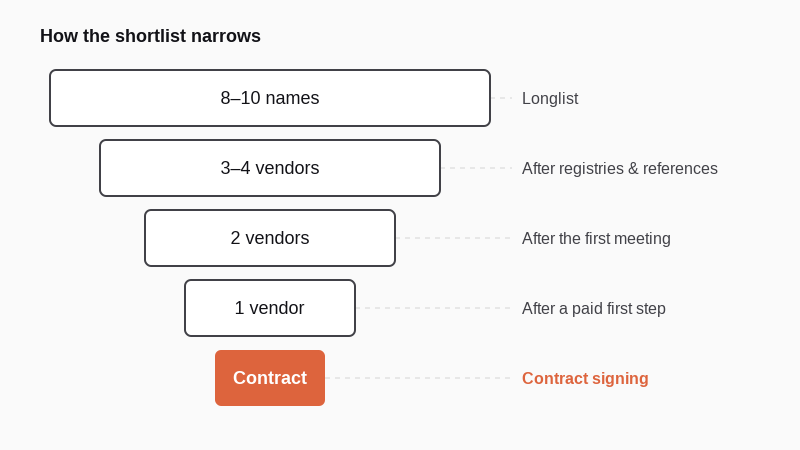
We recommend four steps: registries and references, a meeting with identical questions, a paid first step, and only then a full project contract.
Before your first meeting, all you need is the company ID (IČO) from the quote:
Sole traders appear in ARES and ISIR, usually not in the Commercial Register. Different copyright rules apply to their code (see below).
Registries do not reveal team quality. That is what the first meeting is for.
The first meeting reveals what registries cannot: who will build the project and how the team works. Ask every vendor the same questions and compare answers. Request that the future project lead attend, not just a salesperson.
| Question | Good answer | Red flag |
|---|---|---|
| Who will work on the project? | Names and roles, including subcontractors | "We'll see based on capacity" |
| How did you arrive at the price? | A range with written assumptions | A single number without asking a question |
| What would you cut from version one? | A concrete proposal of what can wait | "We'll build everything" |
| How are changes priced and approved? | A defined process with an estimate before work starts | "We'll figure it out" |
| How do you test? | Automated tests and a staging environment | "You will handle testing" |
| How often will we see working progress? | A demo every one to two weeks | Only at the end of the project |
| How do you use AI tools and who reviews code? | A human reads every change; automated security checks run | Nobody reviews it, or they do not know |
| Where will the app and data run? | Specific provider and country, plus a data processing agreement | "On our server" with no details |
| What happens after launch and what does operation cost? | Support with response times and estimated monthly costs | Support "as available" |
| When do we get the source code and documentation? | Continuously, in a repository under your company's name | Only after final payment, or never |
| Whose name will the accounts be in? | Domain, hosting, and app stores in your company's name | In the vendor's name "to save you the hassle" |
| How much of our time will you need? | Specific roles and weekly hours | "We don't need anything from you" |
If a subcontractor does part of the work, ask who will access your data and whether the vendor will notify you before replacing them. For personal data, GDPR (Art. 28(2)) prohibits engaging another processor without your written authorization.
Ask about artificial intelligence (AI), too. In July 2025, Veracode tested code from over 100 language models: 45% of samples failed security tests. The right answer is not "we don't use AI," but "a human reviews every change and we run automated checks." Also ask where your code and data are sent. Read more in Cybersecurity for businesses.
Hosting, licenses, and support are recurring monthly costs often left out of quotes. We break down total costs in How much does app development cost.
The last question is for you: do you have someone with the time and authority to decide? A vendor who asks for nothing will make decisions alone.
Before signing a full contract, commission a small paid step lasting one to two weeks, such as an initial analysis or prototype. You see how the vendor actually works, and you keep the output.
Discovery (initial analysis) is a standard first phase of development. The UK's GOV.UK Service Manual notes that for public digital services it typically takes 4 to 8 weeks, and that stopping a project after discovery based on its findings is not a failure. A smaller company with a single process needs a shorter, less expensive version.
A good analysis gives you three things:
You also learn whether the vendor delivers on time and speaks up when needed—for instance, telling you an off-the-shelf tool would suffice. We cover when custom builds make sense in Custom software vs. off-the-shelf systems.
Our Initial analysis is for large systems where the configurator only estimates the price. It costs CZK 15,000–25,000 excl. VAT and takes 1–2 weeks. We deduct the amount from the price of the following project. See our custom software development page for the full process.

To switch vendors without rebuilding your app from scratch, three things must remain in your name: the right to use and modify the code, the source code with documentation, and the accounts running the app. Otherwise, you risk vendor lock-in.
Under the Czech Copyright Act No. 121/2000 Coll., a computer program is a copyrighted work (§ 2(2)), protected including its preparatory materials (§ 65(1)). Under Czech law, economic copyright rights cannot be transferred (§ 26(1)), so you cannot simply "buy the copyright." Instead, you can acquire the right to exercise those rights or a license defining how you may use the work.
Who exercises the rights depends on who wrote the code:
Whatever your contract omits is filled in by the Czech Civil Code (Act No. 89/2012 Coll., effective January 1, 2026). For custom software development, those defaults are rarely enough:
An exclusive license only stops the vendor from licensing the same work to others (§ 2360). It says nothing about modifications. Without modification rights, you may only fix bugs and make changes strictly needed to run the software (§ 66(1) of the Copyright Act).
For everything built specifically for you, ask for an exclusive license, unlimited in territory and duration, with rights to modify, sublicense, and hand the code over to another vendor, with the license fee included in the project price. For components the vendor reuses across clients, a non-exclusive license is fine, provided it is also unlimited in time and includes modification rights.
Require the vendor to commit source code continuously from day one to a repository registered in your company's name. Make handover conditional on documentation that lets another team build, run, and deploy the app.
Your domain, hosting, cloud accounts, app store developer accounts, repository, analytics, and email service also belong in your company's name. Give the vendor access; keep ownership. See the Keychain section of Who owns your website for a checklist of accounts.
When a project goes wrong, five sections of a custom software contract matter most:
These five clauses are the minimum. Have a lawyer review any major project contract. This article is not legal advice.
When several red flags appear together, slow down—even if the quote is the lowest.
Be cautious when a vendor:
Compare the remaining proposals in a scoring table: rate each criterion from 1 to 5, multiply by its weight, and total the scores. Price is only one of five factors.
| Criterion | Weight | What to look for |
|---|---|---|
| Process | ×3 | estimate with assumptions, testing, regular demos |
| Team | ×3 | named people, in-house staff, code review |
| Ownership and contract | ×3 | license with modification rights, code and accounts in your name |
| References | ×2 | verified with a client you chose yourself |
| Price | ×2 | exact inclusions, including operating costs |
We walk through the build phase in How web and mobile app development works. Our custom web applications start from CZK 60,000. You can estimate your project's scope and budget in our project configurator.
Choose a software development company by how they work, not by price. Check them in ARES, the Commercial Register, and the ISIR insolvency register, then call a past client. Ask who will build the software and what stays in your name.
With a company employing developers, you get only what the contract grants. Under Czech law, economic copyright rights cannot be transferred (§ 26 of the Copyright Act). You exercise economic rights automatically (§ 58(7)) only when an individual contractor writes the program. Ask for an exclusive, unlimited license with modification and handover rights.
Vendor lock-in happens when you cannot move your app to another developer because you lack the code, documentation, accounts, or license rights. Avoid it by securing a license with handover rights, keeping the repository and accounts in your company's name, and making documentation a condition of acceptance.
For a larger project, yes. An initial analysis defines the version-one scope and gives you a fixed price for the next step. Make sure the output is delivered as a document you can use with another vendor.
A custom software development contract should cover scope, acceptance, change requests, warranty, support, termination with code handover, liability, and licensing. If the vendor processes personal data, add a data processing agreement under Art. 28 of the GDPR.
Handpicked topics for you
Off-the-shelf software covers most daily work. Build custom only what sets you apart. Use our quick test, see where no-code hits its ceiling, and compare five-year costs.
Fixed price looks safe, yet risk hides in a markup or change disputes. See why estimates are uncertain and how to pick a payment model for your project.
Development is just the tip of the iceberg. See what drives custom app pricing, what five years of operation and growth cost, and how to compare quotes.